
The chair of a regional workforce development organization invited me to observe one of their regular meetings before we discussed the rest of their governance accountability. The agenda held three items. The first was approval of the annual budget, which the staff had built within the reserve policy the board adopted two years earlier. The second was the annual review of the executive director’s compensation. The third was whether to expand from a single-county program to a regional model after the state changed how it funds job training.
The board handled all three decisions in the same way. A committee studied the question, brought back a report, and the full board voted at the following meeting. That approach had served them for years, and it worked well for the first two items. The budget passed in ten minutes because it followed a policy and the budget planning cadence the board had already set. The compensation review went to a committee that brought in an outside consultant, gathered salary data from comparable organizations, and returned with a clear recommendation.
The regional expansion question had appeared on agendas for nine months. A committee had gathered enrollment data, interviewed employers and agencies in neighboring counties, and written a forty-page report. By the time the report reached the board, two employers had changed their hiring plans, a neighboring organization had launched a similar program, and the board was debating findings about a market that no longer looked the same.
After the meeting I shared what I had noticed with the chair. Their routine of committee study, written report, and a vote at the next meeting suited the budget and the compensation review, but it slowed the expansion decision.
Most boards settle on one routine for an agenda because it worked the first few times and everyone knows how it runs. This board had waited nine months on the expansion while the executive director asked for direction at every meeting, and each new question still went to a committee for months of study that could not answer it. I asked the chair whether the board would look at how it makes decisions and consider a decision framework. Many frameworks exist, and a board benefits from looking at several, but the one I suggested is effective and efficient, and I have seen it work for boards of many sizes.
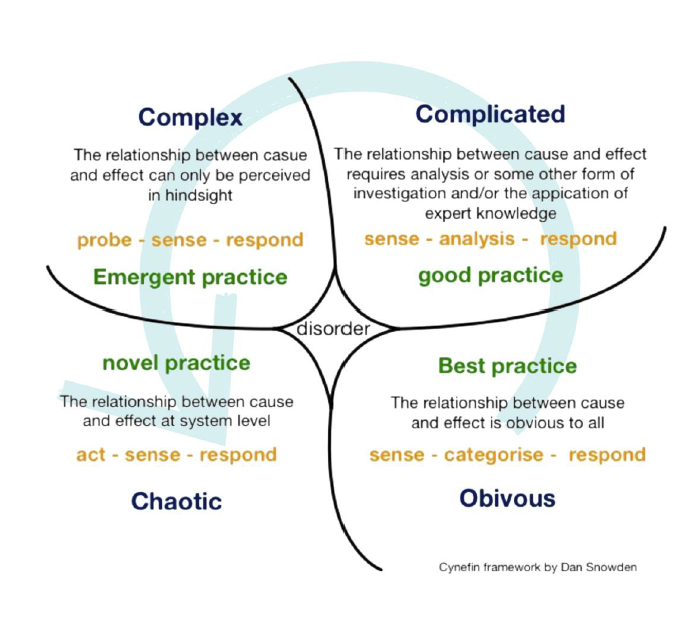
The framework is called "Cynefin," a Welsh word for habitat, a place where you stand and make sense of what surrounds you. The framework sorts situations into domains. In the "clear" domain people know the cause and the right response, and they apply the agreed practice. In the "complicated" domain, experts can analyze the situation and recommend an answer. In the "complex" domain, answers emerge from small experiments that people watch and adjust. In the "chaotic" domain, the first task is to act and steady the situation, and understanding follows.
The five Cynefin domains and the decision sequence each one calls for, drawn from the framework Snowden and Boone describe.
The budget belonged in the clear domain, since the board had already decided how reserves would be handled. The compensation review belonged in the complicated domain, where a consultant could analyze market data and recommend a range. The regional expansion sat in the complex domain, and nine months of study had treated it as though it were complicated. A market in motion invites a board to try a limited step, listen to employers and participants, and adjust.
We spent two sessions with the board sorting the past year’s strategic decisions into the four domains. Several members said the exercise explained why the expansion question had felt stuck for nine months.
Three changes followed. First, the chair began identifying the kind of decision at the start of each agenda item. The naming takes under a minute, and it changed the conversation every time, because members knew whether the board was applying a policy, hearing from experts, or planning an experiment.
Second, the board approved a six-month pilot in one neighboring county, run with a partner organization. A board member and a staff member joined each partner meeting, the board invited employers and participants to say what was working, and a review date went on the calendar before the pilot began. Employers and participants helped refine the next version of the model, and the board saw results within the first quarter.
Third, the board wrote a one-page protocol for urgent events. It lists the situations in which the executive director, the board chair, and the treasurer may act immediately to protect the organization’s cash position and relationships. It asks the executive director to call the chair within two hours, and it calls for a written account to the full board within a day and a board conversation within a week.
Four months later, the state notified the organization on a Thursday afternoon that it would not renew the organization’s largest contract. The executive director called the chair within the hour, paused discretionary spending, briefed the staff, and phoned the lead funders, all as the protocol allowed. She sent the board a written account the next morning. The conversation at the following week’s board meeting was a debrief and contained no second-guessing. The pilot results gave the board something concrete to work with as it turned to the organization’s next stage. The executive director told me later that the board’s trust felt different to her, because the board had told her in advance what she could decide.
Trust, transparency, dignity, and partnership each appear in those changes. The executive director received her authority in advance, the board received a written account, and the employers and participants who use the model helped refine it.
The Hive Collective helps boards build decision practices that fit the kind of decision in front of them, from everyday agenda design to crisis protocols, and we help boards compare several decision frameworks before choosing one. Cynefin is a strong example, and a short conversation about the domains of your decisions is a good place to begin.
Join us for Board Buzz on Tuesday, October 27, at 12 PM Eastern for Tools for Board Decision-Making: Every Day or in a Crisis.
Register for Board Buzz, October 27 at the link below